

Queen Cutlery History
Complete Guide to Queen and Schatt & Morgan Knives and History
Queen Cutlery History is a comprehensive, informative resource for anyone interested in Queen City Cutlery Company and its successor, Queen Cutlery Company. In addition the website features information on the related companies, Schatt & Morgan and the Dollar Knife Company. For the first time, knife collectors and historians have access to a knowledge bank of knife photos and descriptions, historical documents, catalogs and articles related to these legendary cornerstones of the American cutlery industry. Our only focus is on knives made in the USA.
In 2018, having produced high quality cutlery using traditional methods for 96 years, Queen Cutlery closed its doors for good. The curators of this website, David Clark, Linda and Fred Fisher and Bob Welch, had previously served as the Queen Cutlery Historical Committee and are now joined by Carl Bradshaw. We are supported in this effort by knowledgeable Queen and Schatt & Morgan collectors from across the USA. The Daniels Family, last owners of the company have graciously donated all related historical documents from the old Queen website. We are grateful to Jan Carter, of iknifecollector.com for contributing the web domain.
⇒ See just below for a Historical Knife Spotlight article on Queen Cutlery’s slim trapper pocketknives, patterns #11, #11EO and #24. Previous Spotlight articles can be found in the Spotlight Archive. The entire collection of 2020’s Historical Knife Spotlights are now available in articles for you to check out and download.
⇒ All new Collector Questions & Comments appear here on the home page.
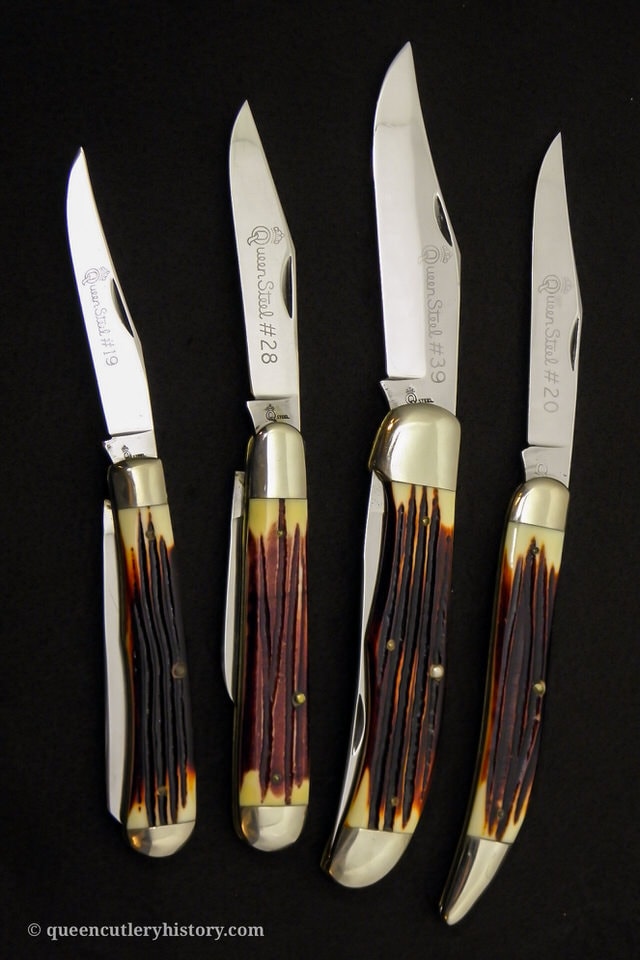
Historical Knife Spotlight
November 30, 2020
This month the Historical Knife Spotlight is focused on Queen Cutlery’s # 11, # 11EO utility and # 24 slim trapper knives. At a quick glance, the patterns look essentially the same, but there are subtle and not-so-subtle differences.
All of these knives have the same visual cues: tapering, with a serpentine curve from the narrowest point at the pivot and curving upward at the wider end of the handle. Some might call this a dogleg pattern but we have not seen use of that term in Queen Cutlery documentation. All have nickel silver bolsters at either end and brass liners in the frame. All have clip blades with a nail nick. All were made with stainless steel “Queen Steel” blades.
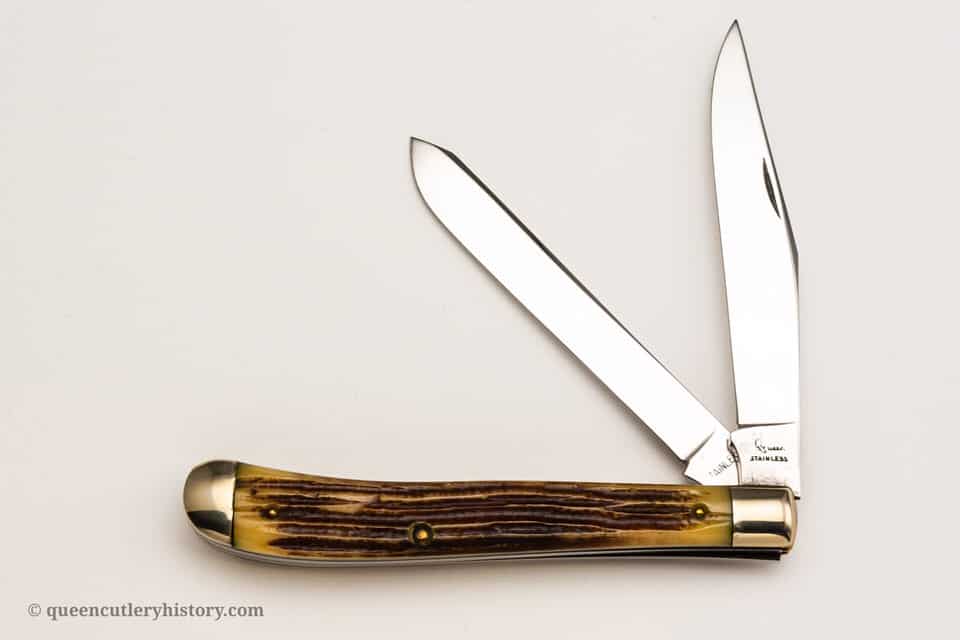
Despite many similarities these knife patterns also have strong differences. Most obvious is the fact Queen # 24, with two blades of approximately equal length, fits the accepted definition of a Trapper. In addition to the clip blade, # 24 is also equipped with a long spey blade, pivoting at the same end. It is thicker by roughly 1/8th inch. This knife has two backsprings and a third brass liner, which account for the increased thickness. In contrast, # 11 and # 11EO have just the one clip blade, two brass liners and a single backspring.
Another big difference is the length of the knives. While # 11 and # 11EO are 4 1/8 inches closed, the # 24 pattern is an even 4 inches. This would not be very obvious if you were viewing examples on a knife show table. Frankly it’s not even all that obvious looking at a # 11 and a # 24 side by side. Queen catalogs are consistent in stating these lengths but it appears to this observer that the difference is more like 1/16 inch, with the the # 24 being a bit longer than the specified 4 inches.
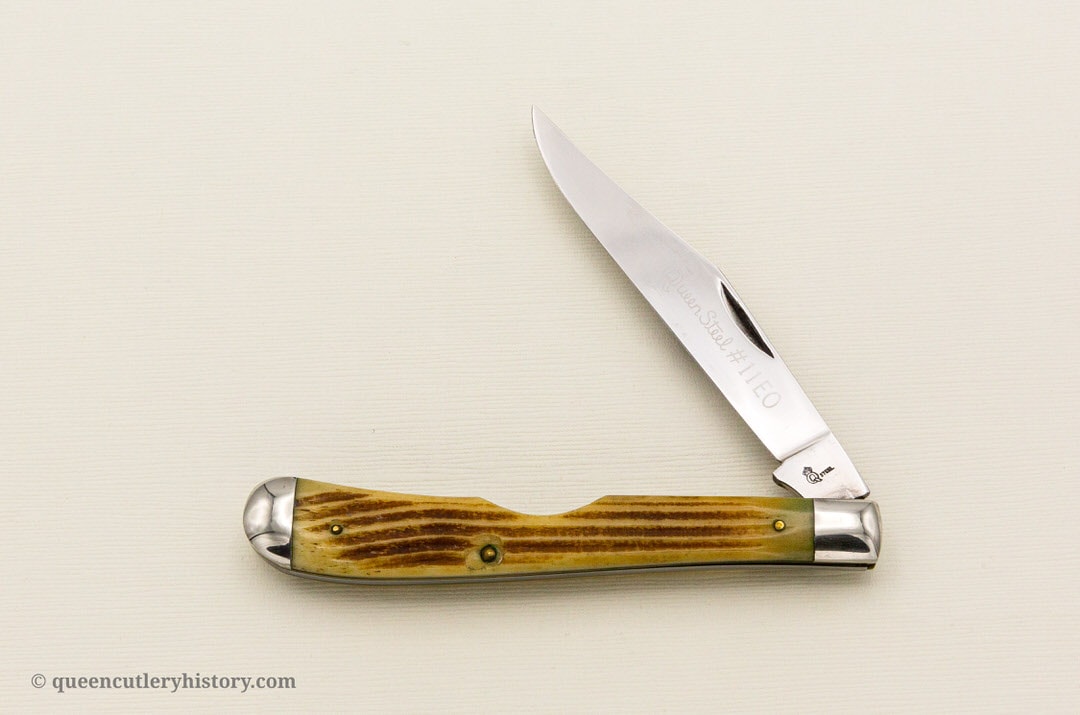
Patterns # 11 and # 11EO differ only in that # 11EO is an easy-opener knife. As the photo shows, there is a semi-circular recess in the handles and liners roughly midpoint on the length. This feature makes it easier to open the blade when, for example, the user is wearing gloves.
Pattern # 11 appears in our first Queen Cutlery catalog, in 1947. At that time and through most of the 1950’s it was referred to as a “Switch”. This name doesn’t mean switchblade but rather has been most often applied to the “Tickler” or “Texas Toothpick” pattern. From the 1959 catalog catalog onward the name used has been “Utility knife”. In the first catalog appearance in 1947 # 11 was offered with Rogers bone handles, as in the accompanying photo.
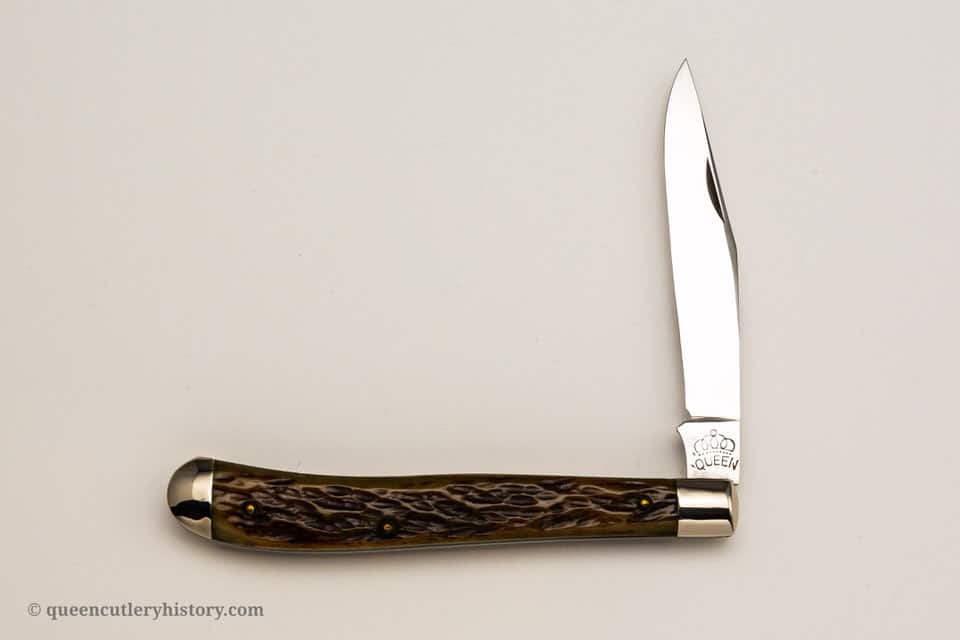
For a short period in the late 1950’s burnt orange imitation winterbottom bone handles were used. More common though, were versions in Winterbottom bone and imitation winterbottom bone (Delrin).
The last appearance of # 11 Utility was in the 1982 catalog by which point it was only offered with imitation winterbottom bone handles and the length was noted as 4 inches. Queen also made # 11 knives as a promotion for Colgate Palmolive’s Irish Spring soap. A photo of this knife appears
in our Knife Library. It has an Irish Spring blade etch and Queen (script) tang stamp. The soap was launched in the USA in 1972 though the tang stamp on the blade indicates 1950’s production. It’s possible old stock was used for at least some of these knives.
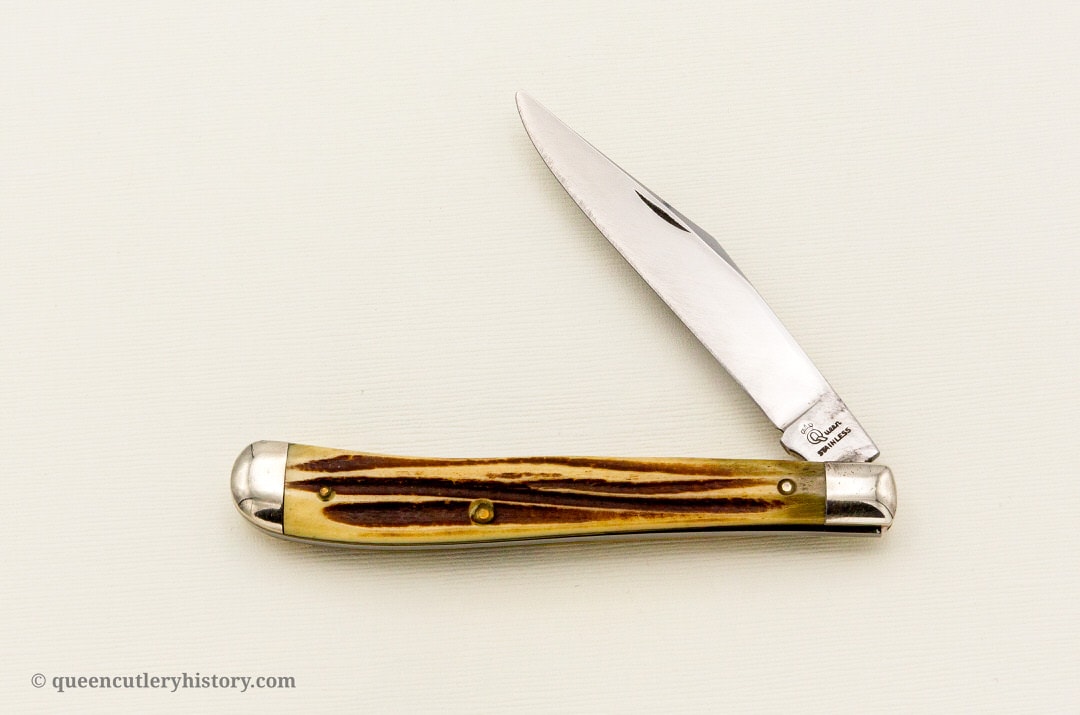
Queen offered this same knife with different handle materials. Pattern # 12 , with simulated pearl synthetic handles first appeared in 1955. The following year saw the launch of # 41, red synthetic handled Utility. The synthetic Amber handled # 13 came along in 1959.
The Easy Opener # 11 EO first appeared in Catalog 93 for 1959 and had a long run, into the 21st century.
The true trapper of the bunch, # 24, Slim Trapper, also appears in the 1947 catalog. This popular knife had a long run, appearing for the last time in the 2009 catalog as # 24BEM-T, denoting Birdseye maple handles. The listing for # 24 in the 1965 catalog made note of the fact it was “… one of our best selling numbers”. Like the # 11 pattern, Queen’s # 24 was offered, at various times with handles of Rogers bone (early days), burnt orange imitation winterbottom bone, Winterbottom bone and imitation winterbottom bone.
Whether called switch, utility, slim trapper, mini trapper or dogleg, these distinctive Queen Cutlery knives were attractive, well made and highly functional. Any one of them will make a great addition to your collection.
A new Historical Knife Spotlight is published each month. You can see past editions in the Historical Documents section of this website.
Queen Cutlery Identification Guide
Updated to version 9 (October, 2023)!
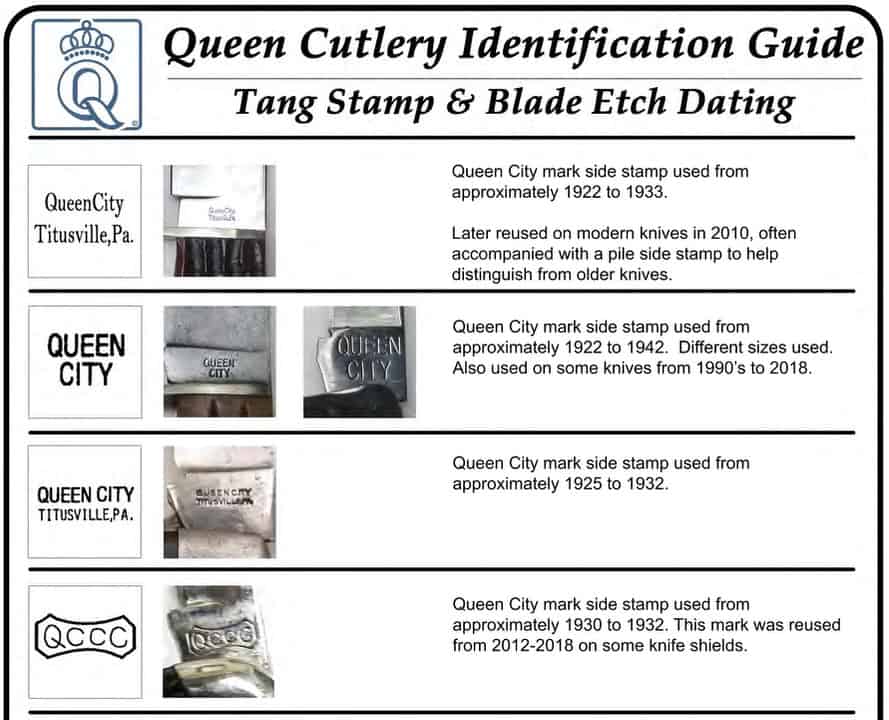
Tang Stamps – Blade Markings – Production Dates
The most comprehensive and extensively researched guide to Queen and Schatt & Morgan tang stamps and blade markings ever published has just gotten better! Version 9 (October, 2023) of the guide is now a 19 page document which displays over 100 distinct tang and blade markings used by the cutleries over a span of 126 years. Two supplements have been integrated into the Guide. One covers hatchets, razors and scissors. The other details additional brands made by Queen, Dollar Knives, Robeson and Tuna Valley.
This Guide was created by our editors and a group of collectors following the 2018 closure of Queen Cutlery. Markings on knives in their various collections, both tang stamps and blade etches, were photographed, in color and (with few exceptions) are included here.
In addition to the photos, an illustration of the stamp or etch marking is included . This is followed by a description and an accurately estimated time span during which that marking was used.
To view and download, just click the adjacent image.
Collectors Questions & Comments
Bruce B. Contacted us with a blade steel question: When did queen cutlery start using D-2 steel? And does the whittler #48 contain D-2?
QCH answered: Queen started using D2 steel in 2002. The #48CSB (carved stag bone) knives produced after that date had D2 blades.
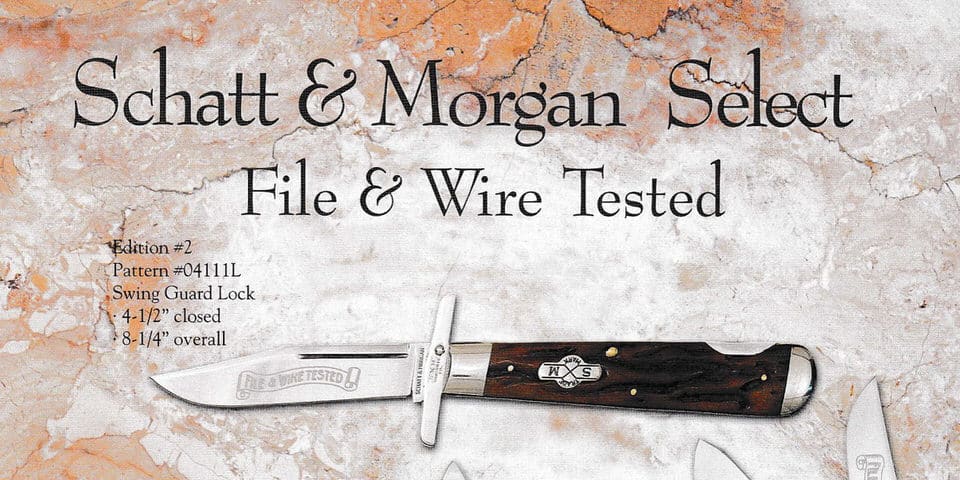
Brian N. Asked about the bone jigging on a modern Schatt & Morgan lockback: I have a S&M swing guard lock back, 04111L, with handles that I do not know the proper term or name for. The spear point blade is stamped 2001 and etched Schatt and Morgan 1of 100. The handles are bone, the color of a overly ripe banana peel and the jigging is fine textured, almost in a narrow V shape. Can you please tell me the proper name for this handle and this type jigging? Thank you for your response.
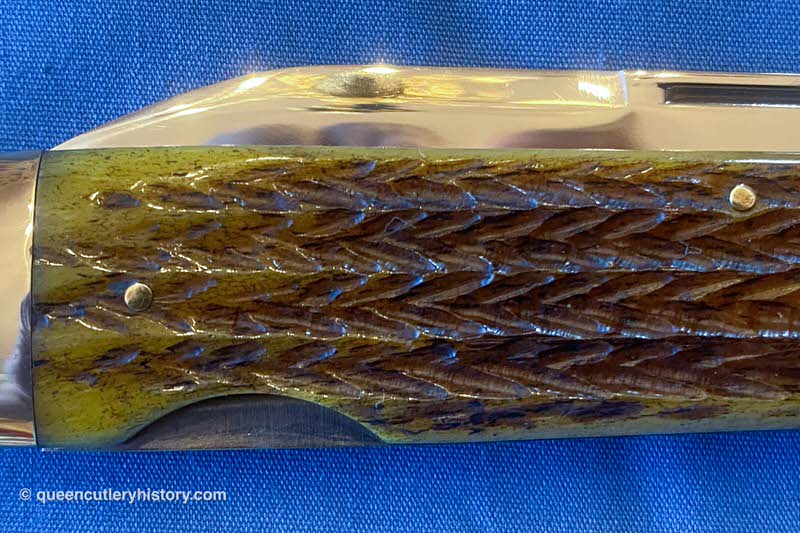
After our team discussed this herringbone jig pattern, QCH replied: Queen produced over 100 variations of the swing guard folder over a 25 year period, beginning in 1992, including the 04111L lockback. That pattern number is specific to the Schatt & Morgan line. About 80% of these knives were either special projects or special orders, meaning just about 20% appeared in a catalog or flyer.
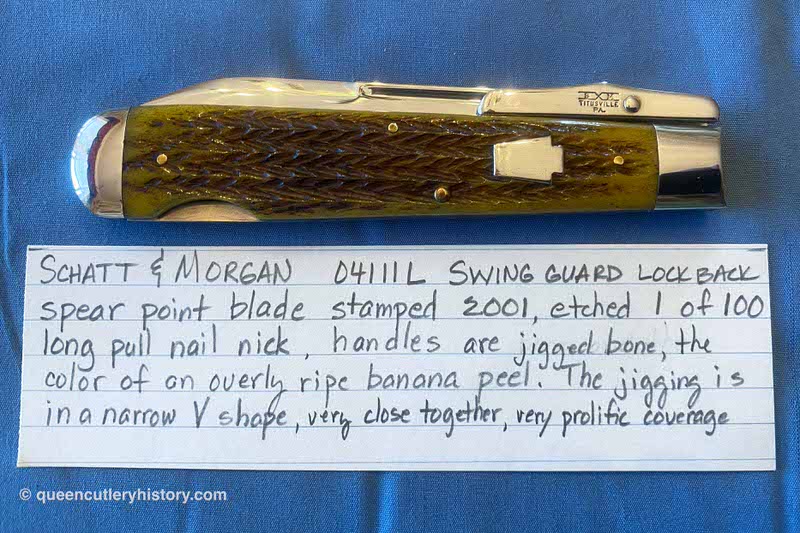
After our team discussed this herringbone jig pattern, QCH replied: Queen produced over 100 variations of the swing guard folder over a 25 year period, beginning in 1992, including the
04111L lockback. That pattern number is specific to the Schatt & Morgan line. About 80% of these knives were either special projects or special orders, meaning just about 20% appeared in a catalog or flyer. The variations included handle material, color and jig pattern (if any), as well as blade type (usually spear or clip). Some had a lower bolster and some were bareheaded.
It sounds as though your knife may have been one of these special orders or special project knives.
Nickolas G. wrote with questions: The #49 stockman with no tang stamp. Is this carbon steel? Why was there no tang stamp on these? Thank you for your time! This website is a fantastic resource.
QCH replied: The #49 first appeared in the 1954 catalog, long after Queen transitioned to stainless steel blades.
Tang stamps were not used from 1961 to 1971, likely dating your knife to that time period. See page 7 of the tang stamp guide.
Nickolas G. had still more questions: Thank you, Sir. When did Queen transition to Stainless? Did they only use stainless after a point? Is it a special stainless that isn’t brittle or better than most stainless? Or was this a way to save money? I did see that some if the older patterns are definitely carbon. Did they ever have this pattern in carbon with the winterbottom bone? If you can’t tell I’m new to the Queen brand. I did however visit the empty factory a few years back, during one of the GEC rendezvous.
Thank you for your time!
In closing, QCH wrote: You’re welcome. Queen started using stainless, at least in a limited way, in the mid-1920’s. After World War II most of their blades were using 440 C stainless. As mentioned earlier, the #49 pattern wasn’t introduced until 1954 or so. By that time virtually all blades were made with stainless.
If you would like to learn more, a great place to start would be Dr. David Krauss’ article, “The Rise & Fall of Queen Cutlery”, on this page.
Dave M. Used our contact form: Hello, I have a block letter Queen City hunter fixed blade I’m trying to find info on. It is not listed on the site. I can send photos. Thank you.
QCH requested a photo and received this, along with more from Dave: I’m trying to find the model number for this knife and was wondering if there were other sizes and variations. This is the basis for the GEC hunter knives and Bill Howard ran production for Queen for some time before starting GEC. Any help is appreciated
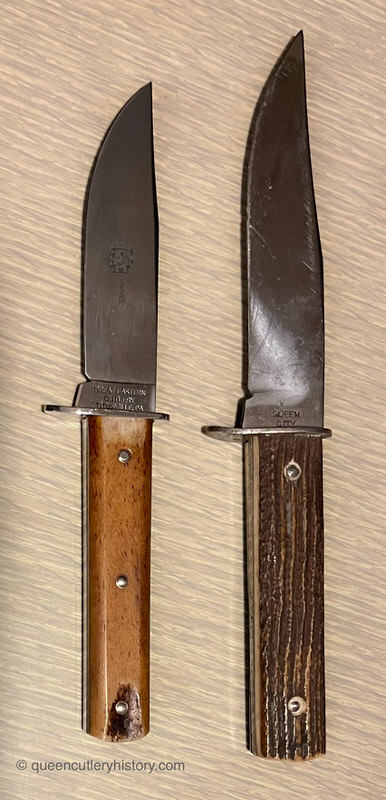
We also asked for the overall length and blade length of the knife, which we learned were 4 1/2 and 8 1/4”, respectively. Then responded: I polled the rest of our team. Some have seen knives like this but none of us own one. Queen didn’t publish catalogs until after WWII so we have no record of it.
The closest Queen pattern is the #73. I say closest because it has a flat ground blade and is bareheaded with 2 rivets and a bone handle. However your knife differs in that the blade is 1/2 inch longer and has a stamped steel, rather than cast aluminum guard.
Highlights for Collectors
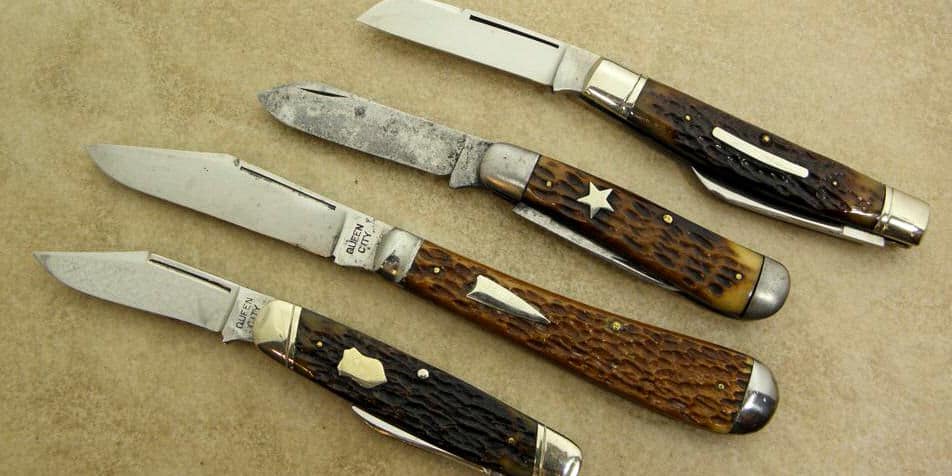
Knife Library
- hundreds of photographs and descriptions of Queen, Schatt & Morgan and Dollar Knife Co. knives, some dating back to the 19th century.
- folding knives, sheath knives and tableware.
- Organized by pattern number
Historical Documents
- Articles written by Queen historians such as David Clark, Dr. David Kraus and Bob Welch.
- Queen company documents
- Historical Knife Spotlight archive
Catalogs
- Complete collection of Queen Cutlery catalogs
- Located within Historical Documents
- Promotional and sales materials
- Product flyers and price lists
- Downloadable, full color pdf’s
Flyers & Ads
- Cutlery advertisements
- Promotional materials from Queen City, Queen Cutlery and Schatt & Morgan
About
- Biographies of Queen Historians
- Contact Us
- Privacy Policy